


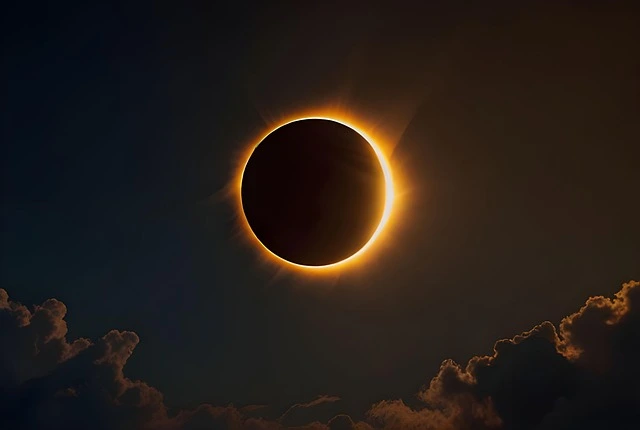
First Solar Eclipse of 2026 – On February 17, 2026, the sky over Antarctica will put on a show most of us can only imagine. This isn’t just another solar eclipse; it’s a rare “Ring of Fire” annular eclipse, and unless you’re bundled up at the bottom of the world, you’ll have to settle for photos. While millions are curious and hopeful, nobody in India will catch even a glimpse. In fact, hardly anyone outside Antarctica and a few nearby polar regions will see the full spectacle, making this one of the most exclusive solar eclipses in years.
Still, the world can’t help but pay attention. Scientists are buzzing, and for good reason. The event isn’t just stunning it’s also a big deal for solar research. Teams at some of the most isolated research stations on Earth are gearing up with specialized telescopes and gear. For them, this eclipse is a rare chance to study the Sun, Moon, and atmosphere under near-perfect, icy conditions.
What Makes the First Solar Eclipse of 2026 So Special?
It’s all about how it lines up. An annular eclipse happens when the Moon slides in front of the Sun but sits just a bit too far from Earth to block all the sunlight. Instead, you get that bright, fiery ring around the Moon’s dark center the iconic “Ring of Fire.” Unlike a total solar eclipse, an annular eclipse doesn’t turn day into night. The world doesn’t go dark, but honestly, it’s still mesmerizing. That glowing ring is enough to make even seasoned astronomers stop and stare.
Date and Global Timing of the Eclipse
The first solar eclipse of 2026 will occur on Tuesday, February 17, 2026.
The show starts over the Southern Ocean, builds to its brightest around 12:12 UTC, and then fades as the Moon’s shadow slips off the Earth. The main act the annular phase lasts just a few minutes, and you’ve got to be right in that narrow, frigid path to see it in all its glory.
Where Will the ‘Ring of Fire’ Be Visible?
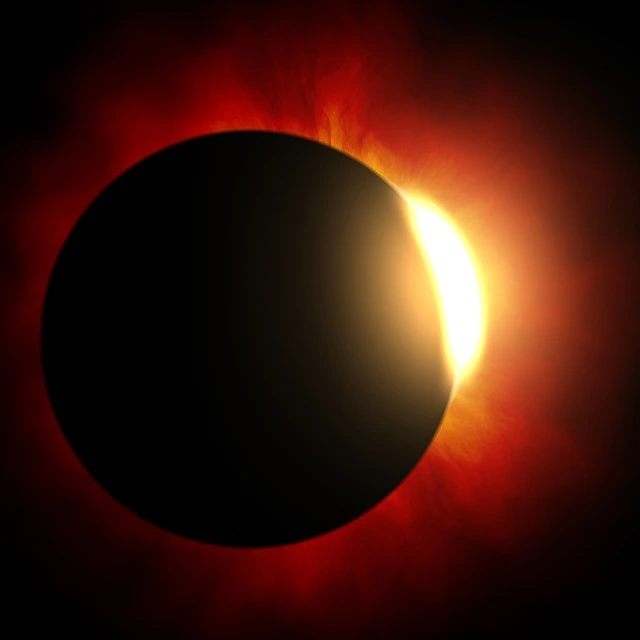
So who actually gets front-row seats? Pretty much just Antarctica and some neighboring polar spots.
Two research stations Concordia and Mirny sit right in the path, making them the places to be for eclipse chasers with a taste for adventure (and a high tolerance for cold). Elsewhere, a sliver of southern Africa, parts of southern South America, and big stretches of ocean will catch a partial eclipse. But India? Not even a shadow. The Moon’s path misses the country entirely, so there’s nothing to see not even a faint bite out of the Sun.
Why India Will Not See the February 2026 Solar Eclipse
A lot of people in India are searching for ways to watch, but astronomers are clear: this eclipse skips India completely. The way the Moon’s shadow cuts across the planet just doesn’t line up. For Indian skywatchers, it’ll be business as usual. Still, if you’re curious, you can always tune into live streams and broadcasts from space agencies and observatories around the world.
Why are scientists so excited about this event?
Eclipses are more than just pretty they’re rare moments when the cosmos gives researchers a perfect lab. Antarctica’s crystal-clear, dry air and pitch-black skies (thanks to almost no light pollution) make it ideal for studying how sunlight interacts with Earth’s atmosphere. Teams on the ice will be measuring solar radiation, tweaking climate models, and gathering data you just can’t get anywhere else. Organizations like NASA and international polar groups watch these eclipses closely because they offer a level of control and clarity you don’t find anywhere else on the planet.
So, while most of us will have to enjoy this “Ring of Fire” from afar, for a handful of scientists and polar explorers, February 17, 2026, promises a view and a research opportunity like no other.
Why People Call It the “Ring of Fire”
They call it the Ring of Fire because, during an annular eclipse, the Moon just isn’t big enough to block out the Sun completely. The Moon hangs at its farthest point from Earth, so it looks a bit smaller than usual. That means the Sun’s outer rim stays visible, glowing like a fierce, fiery ring around the dark Moon.
It’s an extraordinary view, particularly against the shadowy Antarctic sky. Using a solar telescope, the glowing ring seems almost surreal. But don’t get carried away staring at an annular eclipse without proper eye protection is seriously risky. The Sun’s light never gets fully blocked, so it’s always dangerous for your eyes.
Wildlife and Environmental Effects in Antarctica
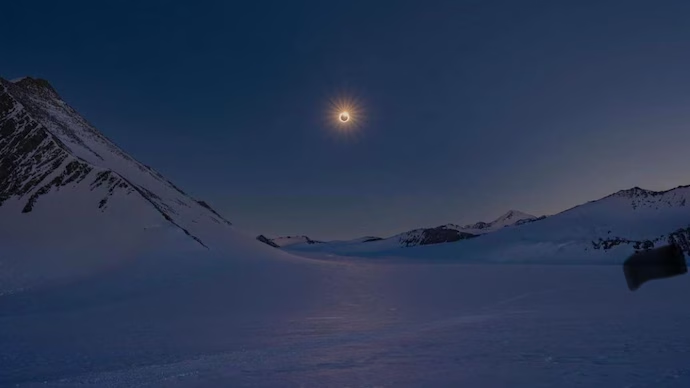
One of the most interesting things about this eclipse is how it might mess with the local wildlife. Scientists have noticed before that animals sometimes act strangely during eclipses birds go quiet, some mammals get confused, all because the light changes so quickly.
Down in Antarctica, penguins, seals, and seabirds rule the place. Researchers are watching closely to see if the brief dimming of sunlight makes these animals do anything unusual. There probably won’t be any long-term effects, but these short bursts of odd behavior tell us a lot about how animals handle sudden shifts in their environment.
How Scientists Will Watch the Eclipse
Not many places get to see the full annular phase, so the scientists on site are getting everything just right. They’re bringing solar telescopes with special filters, high-res cameras, atmospheric sensors, and tools to measure radiation. The data they gather during this first solar eclipse of 2026 will go into bigger studies about how the Sun works and how the Earth and Moon move together. Every observation helps sharpen predictions for future eclipses, too.
Can You Watch the Eclipse From India?
If you’re in India, you won’t catch the eclipse in the sky. But you’re not out of luck. Live broadcasts from observatories and space agencies let you watch everything in real time, with experts explaining what’s happening as it unfolds. Honestly, watching a livestream is not just safer it’s often a better view than being there in person. You get close-up shots of the Ring of Fire that even some scientists on the ground might miss.
How This Eclipse Fits Into 2026’s Eclipse Calendar
This February annular eclipse is just the opening act for a big year in astronomy. Later in 2026, there’s a total lunar eclipse visible from lots of places, and then a total solar eclipse in August. That one’s special, crossing over parts of Europe like Spain and Iceland. The February eclipse stands out because it’s remote and scientifically important, not because crowds of people will be watching.
Why the February 2026 Eclipse Still Matters to India
Even if you can’t see it from your backyard, this eclipse still matters. It reminds us that these cosmic events don’t care about borders they’re global, shaped by the orbits of our planet and Moon. For students, teachers, and sky fans in India, the eclipse is a great excuse to dive into topics like solar eclipses, orbital dynamics, and even how scientists do research in the world’s harshest places. It also builds excitement for the next eclipses that will actually be visible in India.
Safety Reminder: Don’t Look at the Sun
No matter where you are, the same rule holds: never look straight at the Sun without proper eye protection. Annular eclipses are especially tricky because the Sun never gets fully covered up. This warning goes for everyone photographers, scientists, and anyone just curious.
A Rare Eclipse in a Remote World
India might miss out on seeing the first solar eclipse of 2026, but the event is bigger than any one place. In Antarctica, scientists will watch as the Moon slices a shining ring into the Sun, gathering new knowledge that pushes our understanding of space a little further. For the rest of us, this eclipse is a reminder: some of the most amazing things on Earth happen quietly, far from the crowds, out at the edges of the world. Even when we can’t see them, these moments connect us to the universe and keep us reaching for answers in the sky.