



A Historic Victory for Indian Cinema
Boong BAFTA win India – A first for any regional Indian film on the global stage, Boong has put Indian cinema on a world map with its historic win of the Best Children’s and Family Film award at the 79th British Academy of Film and Television Arts (BAFTA) Awards 2026.
Its success has elicited a flood of congratulations from politicians, film industry veterans and Indian fans emphasizing not just the creative achievement of the film, but also the growing international appetite for stories that spring deeply from India’s regional cultures.
Boong: The Origin of the Film
A coming-of-age drama, Lakshmipriya Dev’s Boong tells a simple, earnest story through the lens of a young boy on a mission.
The film is ironically titled Boong after the young protagonist, whose seemingly naive daydream of finding his missing father turns into a journey rich in emotional complexity and cultural resonance. Set in Manipur, the story treads between universal themes of family, hope and resilience with regional textures that cross cultural boundaries.
In fact, Boong’s world premiere was at the 2024 Toronto International Film Festival and it racked up prestigious festival play around the globe including playing TIFF, the International Film Festival of India and even the Indian Film Festival of Melbourne in 2025, all before its BAFTA win helped it gain some momentum.
The BAFTA Win: A Global Stage, A Local Story
At the 79th BAFTA Awards in 2026, Boong won an award for Best Children’s and Family Film and was placed alongside other international giants like Zootopia 2 and Lilo & Stitch.
This victory is historic on a number of levels:
- This is the first BAFTA win for an Indian film in this category.
- It highlights the capacity of Indian regional cinema to stand up against and beat well-sourced foreign titles.
- The recognition heightens interest in stories that are culturally specific but universally relatable.
When Boong received its BAFTA honor for best long form work, it was a powerful signal to other screenwriters and directors around the world that real, local stories can resonate strongly with global audiences too, rather than spectacular blockbusters alone.
National Reactions: Pride Across India
The BAFTA win did not go by unnoticed back home. Reactions came from politicians and filmmakers to stars, making this a national celebration.
Indian Political Leaders Celebrate
Yumnam Khemchand Singh, Chief Minister of Manipur also congratulated Lakshmipriya Devi, Director and the Boong team who brought glory to Manipur as well as India. He said that the achievement speaks about the creative commitment and storytelling power of talent emerging from northeast India.
The West Bengal chief minister, Mamata Banerjee, said in a statement that Boong had “scripted history” by winning at the BAFTA Awards and made every Indian proud.
The highest honor perhaps came from Prime Minister Narendra Modi, who called the film’s success “a moment of immense joy” that highlights India’s creative talent on a global stage.
Bollywood & Filmmaker Praise
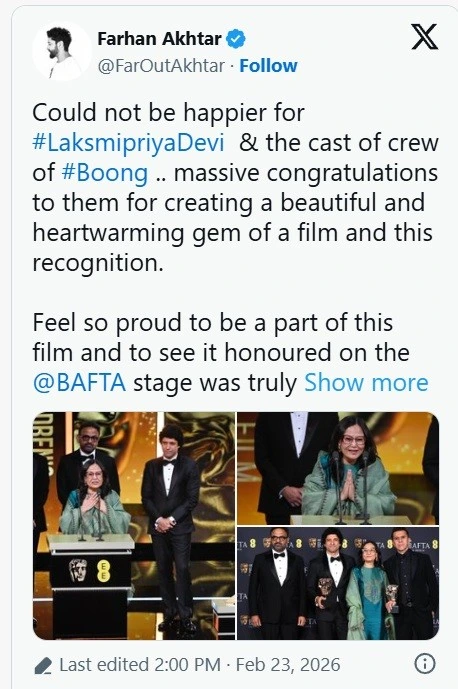
The praise didn’t end with politicians. Also celebrating this watershed moment was India’s film industry, from mainstream Bollywood luminaries to acclaimed directors.
Farhan Akhtar, one of the producers on Gully Boy, extended heartfelt congratulations to Lakshmipriya Devi and the entire cast and crew for their dedication behind the moment adding in that seven minutes at BAFTA were, “unforgettable.”
Legendary filmmaker Karan Johar expressed his pride at the achievement on social media, as he described it as a remarkable moment and one worth celebrating for Indian storytelling.
Kangana Ranaut shared a post praising Lakshmipriya Devi’s achievements and quoted that it was an inspiration for all.
Others stars also joined in, including Dia Mirza, Manoj Bajpayee, Vivek Oberoi and Alia Bhatt besides Siddhant Chaturvedi and Aditi Rao Hydari all congratulated the powerful release as one of Indian cinema’s strongest diverse achievements.
Director Lakshmipriya Devi: Feature Vision and Experience
Lakshmipriya Devi’s accomplishment is noteworthy, not just for its own sake but also for what it symbolizes about the opportunities available to filmmakers in areas that have historically fought against invisibility.
In her, acceptance speech she paid tribute to her homeland Manipur an abode of culture but one which rarely makes it to the national and international stage. Her speech as well had a touching call for peace and attention to the social realities of her home region, highlighting cinema’s ability to raise important discussions.
Boong is her first feature film, and that alone makes for an incredible journey but in demonstrating how engaging storytelling can overcome obstacles with or without a big studio behind you, her’s is one of the most uncanny stories of all.

What This Win Means for the National Conversation
Boong’s great victory is much more than an award it’s an achievement for regional Indian cinema, particularly movies from the Northeast that have typically not received significant attention at home or abroad.
This win:
- It confirms local narratives on international arenas.
- Subscriptions are available and may contain content that inspires filmmakers in under represented territories to reach international acclaim.
- Instills confidence in producers to finance culturally specific stories rather than broad-market models.
- Furthers opportunities for new collaborations, festivals and international distribution.
Movies like Boong suggest that audiences around the world are ready for not only big brands, but also authentic voices and stories representative of the diverse human experience.
A New Era for Indian Stories Abroad
Boong’s win joins a handful of recent moments this year when Indian films made waves on the international stage. But what really distinguishes this is its category, the regional origin, and that it went up against globally known international titles and won.
This achievement signals a shift:
- International awards bodies have noticed the smaller world cinema that exists outside of English-language dominance.
- Not all Indian regional films need to be based on commercial formulas.
- Audiences everywhere are craving heartfelt, human stories, not just spectacle.
How Boong Captured Global Attention
A few things contributed to Boong’s BAFTA triumph:
- Robust festival circuit, screenings at major international festivals
- Genuinely cultural voice that breaks through quilted borders.
- Advocacy for diverse storytelling by well-known producers who bet on the project.
- A story that marries universal feeling with regional specificity, one both relatable and original.
Reflecting on the BAFTA Journey
The BAFTA win is the culmination of years of dedication from film festival premieres to months and years more of global screenings and advocacy. That a film so specifically of a culture should succeed at such an elevated venue is proof of cinema’s power to connect cultures and engender empathy through shared human experience.
Final Thoughts: A proud moment for both India and world cinema
A journey they have undertaken together for years with the Boong BAFTA win India is one of inspiration and transformation. The acclaim coming from political leaders to Bollywood stars to the world by and large proves that this feather in India’s cap is not just about the trophy.
Boong has not only gifted accolades to Manipur and India but also heralded a new era for regional Indian films, an era where divergent voices and authentic stories get their moment in the sun on international stages.
As the world looks on and cheers, Indian cinema is striding taller, broader, surer.