


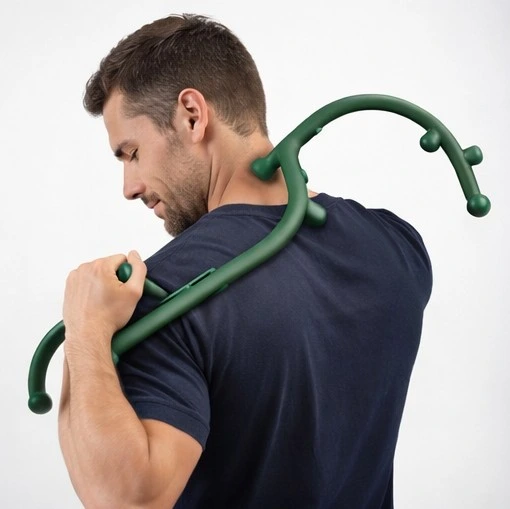
Using a Theracane for the Best Possible Results
That bothersome knot between your shoulder blades. The one that’s just slightly out of reach despite all the twisting, stretching and reaching. It’s a miserable issue, and one that strikes many of us way too often leaving you stiff and sore, desperate for relief. You’ve likely attempted foam rollers or pleaded for a partner to massage you, but sometimes knots are just too compact and deep. But that is where an ingeniously simple tool comes into its own. Get the hang of how to use a Theracane and you have a game changer: suddenly, it’s easy to sit there and pinpoint then release that muscle tension yourself.
This guide will tell you everything you need to know to become a pro with this S-shaped self-massage tool. We will guide you through the basic principles of trigger point therapy and teaches you specific techniques for every part of your body. You’ll learn what to do and what NOT to do, how to find those elusive knots, and how much pressure is perfect for effective, long-term pain relief. are you ready to take charge of your muscle pain and discover a new level of comfort and freedom?
What Exactly Is a Theracane?
Before we introduce the methods, let’s familiarize ourselves with the tool. The Theracane is a manual massage tool, which takes the form of the giant letter ‘S’ or a shepherd’s staff. It’s usually made of a sturdy, slightly bendable plastic and has several knobs, or nodes, that come in various sizes and are arranged in key spots along its curves.
Special design is the greatest advantage. A loopy design and long, curvy handle give you leverage to apply a lot of pressure to hard-to-reach places in your body (like the back) without it taking much effort. The various knobs are meant to replicate the thumb or elbow of a massage therapist and let you perform deep-tissue massage on yourself.
Understanding Trigger Points and Myofascial Release by Coach Lats. The second most common musculature in the pronators that needs attention is probably the Brachialis, Brachioradialis, Extensor Polices brevis & Divisor Communis.
To really figure out how to use a Theracane well, however, you need to first understand what you’re targeting: trigger points. Trigger point is simply a small, hyperirritable spot located in a taut band of muscle. You may be familiar with them as “knots.” These knots can create local pain, as well referred pain which is discomfort in a different part of the body.
So, for example, a trigger point in your upper trapezius muscle (which is between the back of your neck and shoulder) can cause tension headaches. Myofascial release is the key to releasing this tension. This technique employs a steady, light pressure on these trigger points that allows muscle fibers to loosen, lengthen and release their hold. The Theracane is an ideal implement to use for this type of pinpoint pressure you can apply.
How To Use A Theracane Safely and Effectively – Beginning EXECUTE THIS FIRST
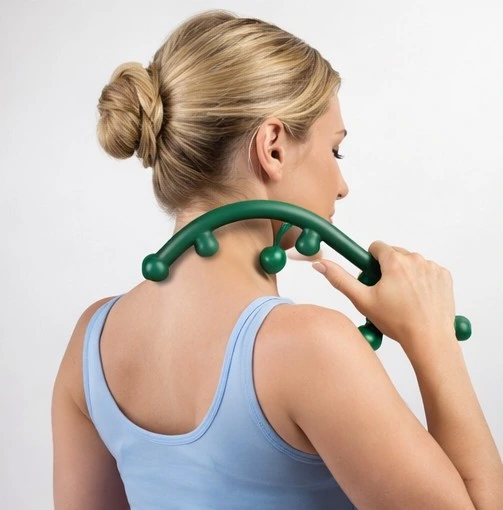
The Theracane is easy to use, but there are a few important things to keep in mind when you start using it so that you
- a) get the most benefit from it and
- b) don’t hurt yourself.
- The idea is to ease tension, not cause more pain.
Find Your Grip and Leverage
Start by becoming comfortable with the feel of your tool. Those long, curved handles are your levers. You can hold one end and use a knob to the muscle you want display, and then another head to pull or push, the handle can regulate intensity.
For back and shoulders, you usually hook the bigger curve over your shoulder. Cup the handle with one or both hands in front of chest. Pull the handle down and away from you for deep pressure massage between your shoulder blades and up the spine.
The Golden Rule: Start Gently
The most common mistake with press-on nails for beginners is applying too much pressure out of the gate. And your muscles need time to adjust. Begin with moderate pressure to feel the area and identify the trigger point. A trigger point will be a tender nodule in the muscle.
When you spot something, don’t immediately try to destroy it. Instead, use as much pressure as feels good to apply and let it hurt so good, not a shooting searing pain. If you’re wincing or needing to hold your breath, you’re pushing too hard. Back off a little.
Breathe and Relax
Your own breath is a huge resource in muscle relaxation. Deep breathe as you sink pressure into a trigger point. Take a deep breath in, and as you let it out, think about relaxing the muscle you are focusing on. Picture the tension dissolving with every exhale. This sends a message to your nervous system to get out of the way and allow the muscle to relax so they massage becomes much more effective.
How Long to Hold the Pressure
When you’ve located a trigger point, and applied gentle sustained pressure, keep holding the pressure for about 20 to 30 seconds. You may find that the muscle begins to twitch or feel more tender during this process. This indicates the trigger point is releasing. After 30 seconds, release the pressure, breathe and exhale several times, then shimmy your thumb a half inch in one direction or the other. You can always revisit the same spot later in the session, but don’t overdo one area. Do 5-10 minutes per major muscle group is all that you need.
How to Do Plyo-Box Jumps: Break It Down 3 Target Muscle Group Variations
Now that you’re familiar with the basics, lets dive into some specific tactics for parts of the body.
Releasing Neck and Shoulder Tension
As we sit at a desk or stare at a screen, our neck and shoulders are a frequent source of pain.
- Upper Trapezius: To get at the muscle on top of your shoulder, drape the Theracane over your opposite shoulder. Press in the fleshy part between your neck and shoulder joint with the knob at the end of the hook. You control the pressure with your hand on the front handle. Hold, breathe, and release.
- Levator Scapulae: This muscle travels from the upper part of your shoulder blade to the side of your neck and is often involved in cases of “stiff neck.” Position the knob on the upper-inner corner of the scapula. Lightly press the handle to distil and release pressure. You may also gently turn your head away from the direction you are creating to increase the stretch.
Ways to Use a Theracane on Your Back
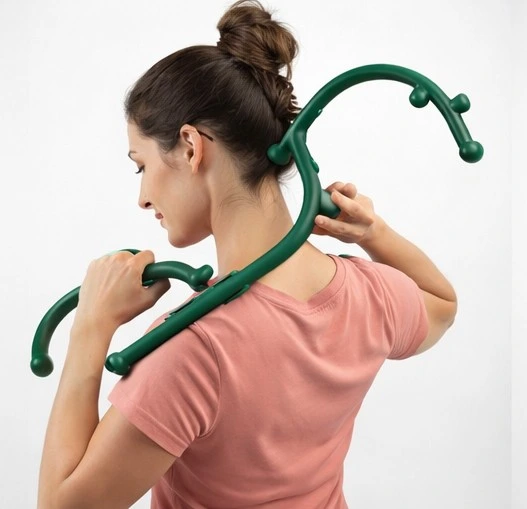
The Theracane is a marvel for the back, reaching places you can never touch on your own.
- Rhomboids and Mid-Back: Target those muscles between your shoulder blades by positioning the Theracane over your shoulder. Put a knob just to the side of, but not on, your spine. Never push down directly on your spinal cord. Move the handle in front of you to apply pressure, making your way up and down between your spine and shoulder blade.
- Lower Back (Quadratus Lumborum): Many cases of chronic lower back pain may be due to tightness in the Quadratus Lumborum (QL). You can do this seated or standing. Put one of the lower knob on Theracane into your soft muscle parts, in side of your lumbar region. Utilize the handles to push the knob in to the muscle. You can also press against the chair with a lean back for more pressure.
Hips and Glutes
Don’t neglect your glutes! Spending all day in a chair can result in tight hip flexors, which is associated with lower back pain and sciatica-like pain.
- Gluteus Medius and Piriformis: Sitting down in a chair or on the floor. Put one of the knobs under your glute. You can get all around the glutes by putting your weight into it and pulling on the handles. The piriformis is a little deep muscle that often gets quite tight. Digging around for tender spots in the middle of your glute will bring you to it.
- Legs and Feet: And though it’s not a primary use, the Theracane can also provide relief to your legs and feet.
- Hamstrings and Calves: in a seated position and you can press the Theracane into your hamstrings, as well as use it for calves. This is especially helpful for runners, or anyone who stands for long periods.
- Plantar Fasciitis: Sit in a chair and slide one of the knobs under your foot, at the arch. Very slowly roll your foot over the knob, massaging just tender spots in the plantar fascia.
Common Mistakes to Avoid
- Bones and Nerves: Remember not to press on bony areas or nerves! Don’t press directly over your spine, collarbone, ribs or front of neck. Be careful of places where the nerves run close to the surface, such as your “funny bone” in the elbow.
- Overdoing It: A little does not get enough, right? A session of 10 to 15 minutes is frequently all you need. Overworking a muscle by hitting it too hard, for example, can cause bruising and increase inflammation, making the problem worse.
- Ignoring Pain Signals: Hear what your body is trying to tell you. There is a difference between the discomfort of a releasing muscle and sharp, shooting or radiating pain. If you have the former, go for it, if you have the latter, cease immediately.
Theracane vs. Other Tools
How does the Theracane compare to other favorite self-massage tools?
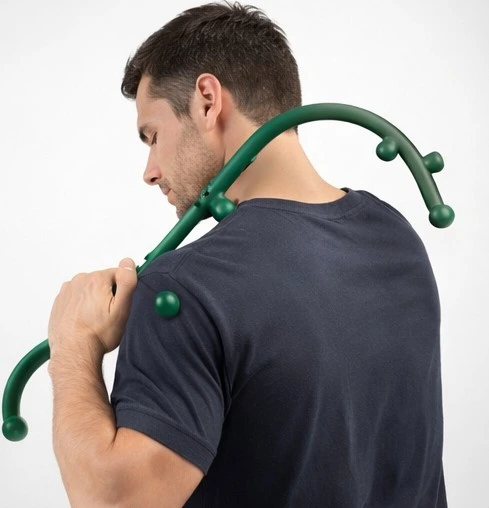
- Foam Rollers: Foam rollers are great for big muscles the quads, hamstrings and lats. They provide broad pressure. The Theracane, however, provides pinpoint accuracy for going deep into certain knots that a foam roller might skip across.
- Massage balls: Lacrosse or massage balls are also perfect for targeted pressure. But they can be unwieldy on your back, you typically need a wall or the floor to exert pressure and that makes for clumsy control. The leverage system of the Theracane allows you a lot more control of pressure and placement.
- Massage Guns: Massage guns use percussion to release muscle tension. They can work really well but are also costly and must be charged. The Theracane is a cheap, powerless tool that’s available at any time without the need for electricity.
When to See a Professional
The Theracane is a great for those day to day muscle soreness and stiffness. But it is not a replacement for professional medical advice. Consult a doctor or physical therapist if:
- Your pain is noticeable, chronic, or worsens with self-massage.
- You have numbness, tingling, or muscle weakness.
- The patient is dealing with a new, acute insult.
- An expert can properly diagnose and develop a treatment plan focused on breathwork, exercises like hanging and other physical activities including perhaps the use of a Theracane in your at-home wardrobe for better body function.
By learning how to use a Theracane the correct way you can take control of your own muscle health. It’s a small investment with huge returns in comfort, mobility and general well-being.